
Carbon Accounting Guide
What are Scope 1, 2 and 3 Emissions?
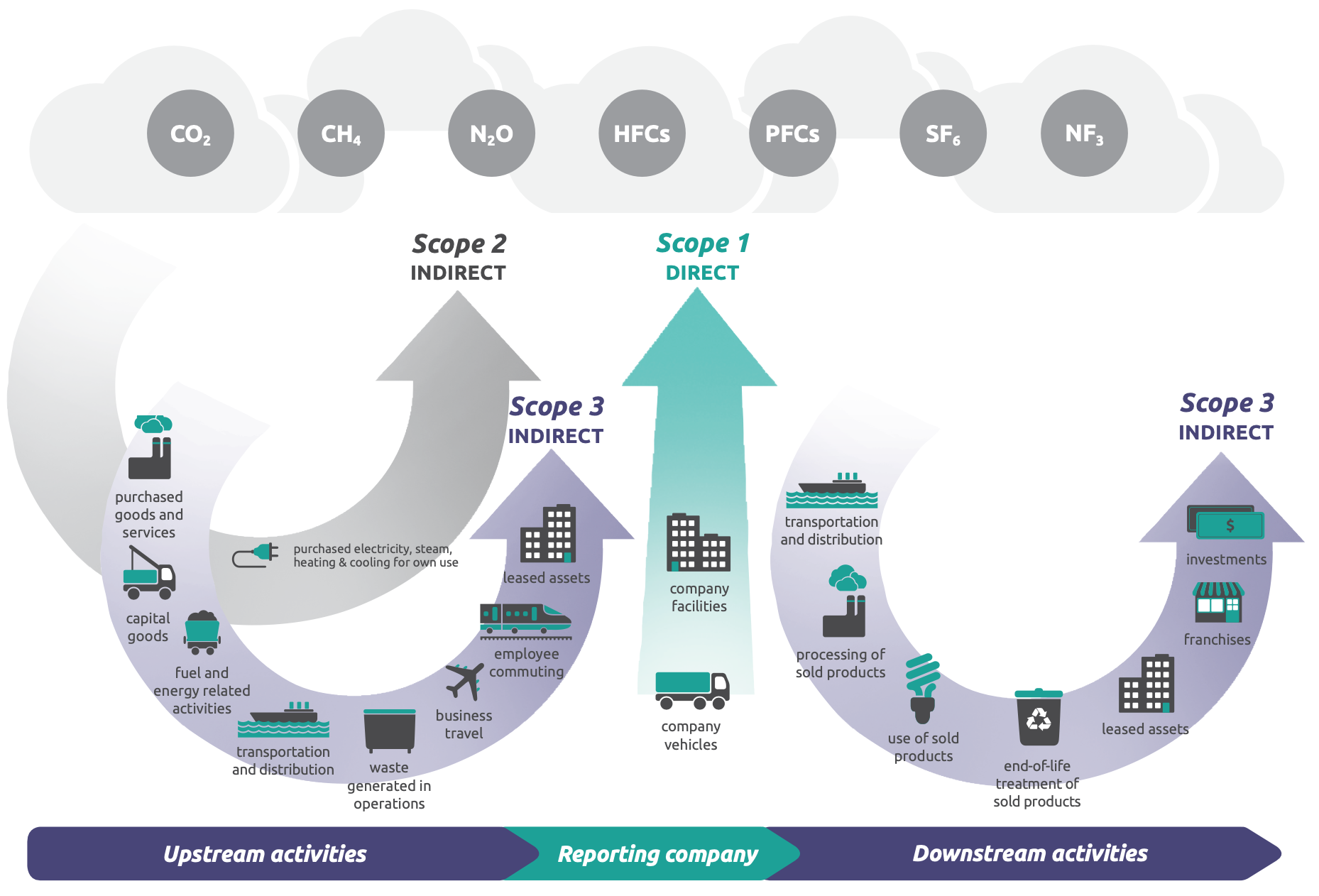
When it comes to understanding a company’s carbon footprint, emissions are categorised into three scopes as defined by the Greenhouse Gas (GHG) Protocol. These scopes provide a framework to differentiate between direct and indirect emissions, enabling organisations to measure and manage their climate impact effectively.
Scope 1: Direct Emissions
Scope 1 emissions are direct greenhouse gas emissions from sources owned or controlled by the company. These are the emissions that result from activities under a company’s direct operational control. Examples include:
- Fuel combustion: Emissions from burning fuels in company-owned boilers, furnaces, or vehicles.
- On-site generation: Emissions from producing electricity, heat, or steam on-site.
- Fugitive emissions: Leaks of refrigerants or other gases from equipment.
- Process emissions: Emissions released during physical or chemical processes, such as cement production, chemical manufacturing, or other industrial activities.
Why Measure Scope 1 Emissions?
Scope 1 emissions are often the easiest to control since they are directly tied to the company’s operations. Reducing these emissions might involve adopting cleaner fuels, improving energy efficiency, or transitioning to electric vehicles.
Scope 2: Indirect Emissions from Purchased Energy
Scope 2 emissions are indirect emissions associated with the production of electricity, steam, heating, or cooling that the company purchases. While the company doesn’t generate these emissions directly, they occur upstream at the facility where the energy is produced.
Key Sources of Scope 2 Emissions:
- Electricity: Emissions from the generation of electricity consumed by the company.
- District heating or cooling: Emissions from centralised systems supplying heating or cooling.
Why Measure Scope 2 Emissions?
Scope 2 emissions often make up a significant portion of a company’s carbon footprint. Switching to renewable energy sources, such as wind or solar, is a common way to reduce Scope 2 emissions.
Scope 3: Indirect Emissions from the Value Chain
Scope 3 emissions are all other indirect emissions that occur throughout a company’s value chain. These are not owned or controlled by the company but are a result of its activities. Scope 3 is often the largest and most complex category, frequently accounting for 80-90% of total emissions, though this varies significantly by sector.
Categories of Scope 3 Emissions:
Scope 3 emissions are divided into upstream and downstream categories:
Upstream Categories:
- Purchased goods and services
- Capital goods
- Fuel- and energy-related activities (not included in Scope 1 or Scope 2)
- Upstream transportation and distribution
- Waste generated in operations
- Business travel
- Employee commuting
- Upstream leased assets
Downstream Categories:
- Downstream transportation and distribution
- Processing of sold products
- Use of sold products
- End-of-life treatment of sold products
- Downstream leased assets
- Franchises
- Investments
Why Are the Scopes Important?
The three scopes provide a structured way to assess the entire lifecycle emissions of a company’s operations. Here’s why they matter:
- Transparency: By reporting across all scopes, companies demonstrate accountability and provide stakeholders with a clear picture of their climate impact.
- Actionable Insights: Identifying which scope contributes most to emissions helps prioritise reduction efforts.
- Regulatory and Market Requirements: Many sustainability frameworks, such as the Science-Based Targets initiative (SBTi), require companies to account for all three scopes.
- Competitive Advantage: Proactively addressing emissions can improve a company’s reputation, attract environmentally conscious customers, and meet investor expectations.
Taking Action to Reduce Emissions
Reducing emissions across all three scopes requires a combination of internal changes and external collaboration:
- For Scope 1: Transition to electric vehicles, optimise fuel use, or adopt cleaner production technologies.
- For Scope 2: Shift to renewable energy sources like solar, wind, or green electricity tariffs.
- For Scope 3: Engage suppliers to reduce their emissions, optimise logistics, and innovate in product design to improve sustainability.
Conclusion
Understanding Scope 1, 2, and 3 emissions is fundamental to addressing climate change. By categorising emissions into these scopes, companies can take targeted actions to reduce their carbon footprint, contribute to global sustainability goals, and future-proof their operations.
The journey to net zero starts with measuring what matters — because only what gets measured can be managed.