Carbon Accounting Guide
What is Carbon Accounting?
Understanding Carbon Accounting and GHG Emissions
Carbon accounting is the process of measuring a company’s greenhouse gas (GHG) emissions — both those generated directly from its operations and those indirectly caused throughout its value chain. These emissions can stem from various activities, including:
- Direct emissions: Such as burning fossil fuels for company vehicles or heating.
- Indirect emissions: Resulting from electricity use, transporting goods, or purchasing products and services from suppliers.
For companies starting their sustainability journey, the first step is conducting a baseline emissions assessment. This provides a snapshot of the organisation’s current carbon footprint and serves as a reference point for future reduction efforts.
Are There Standards for Carbon Accounting?
Absolutely! The GHG Protocol is the most widely used framework for carbon accounting, and most other frameworks and standards are based on it. Even if your data isn’t perfect, don’t worry — the GHG Protocol allows for estimates and assumptions when necessary. The key is starting where you are and improving accuracy over time. See What is the GHG Protocol? for a full breakdown of its standards.
What are Greenhouse Gases (GHGs)?
Greenhouse gases (GHGs) are gases in the atmosphere that trap heat, driving the greenhouse effect and contributing to climate change. The main GHGs include:
- Carbon dioxide (CO₂) – The most prevalent GHG, released mainly from burning fossil fuels, deforestation, and industrial activities.
- Methane (CH₄) – A highly potent GHG with a much greater heat-trapping ability than CO₂, produced by agriculture, waste decomposition, and energy production.
- Nitrous oxide (N₂O) – Emitted from fertiliser use, industrial processes, and the burning of fossil fuels and biomass.
- Hydrofluorocarbons (HFCs) – Synthetic gases used in refrigeration, air conditioning, and aerosols.
- Perfluorocarbons (PFCs) – Industrial gases with extremely long atmospheric lifespans, mainly from aluminium production and electronics manufacturing.
- Sulphur hexafluoride (SF₆) – A highly potent GHG used in electrical insulation and switchgear.
- Nitrogen trifluoride (NF₃) – A synthetic gas used in electronics manufacturing, with a very high global warming potential.
In carbon accounting, emissions from these gases are measured in CO₂ equivalent (CO₂e). This unit standardises each gas’s warming potential, allowing organisations to compare and report their total emissions accurately. Since methane has a much higher global warming potential than carbon dioxide, even small methane emissions translate into a higher CO₂e value.
Understanding GHGs helps businesses assess their environmental impact and take informed steps to reduce emissions.
How are Emissions Categorised? The Scopes of GHG Emissions
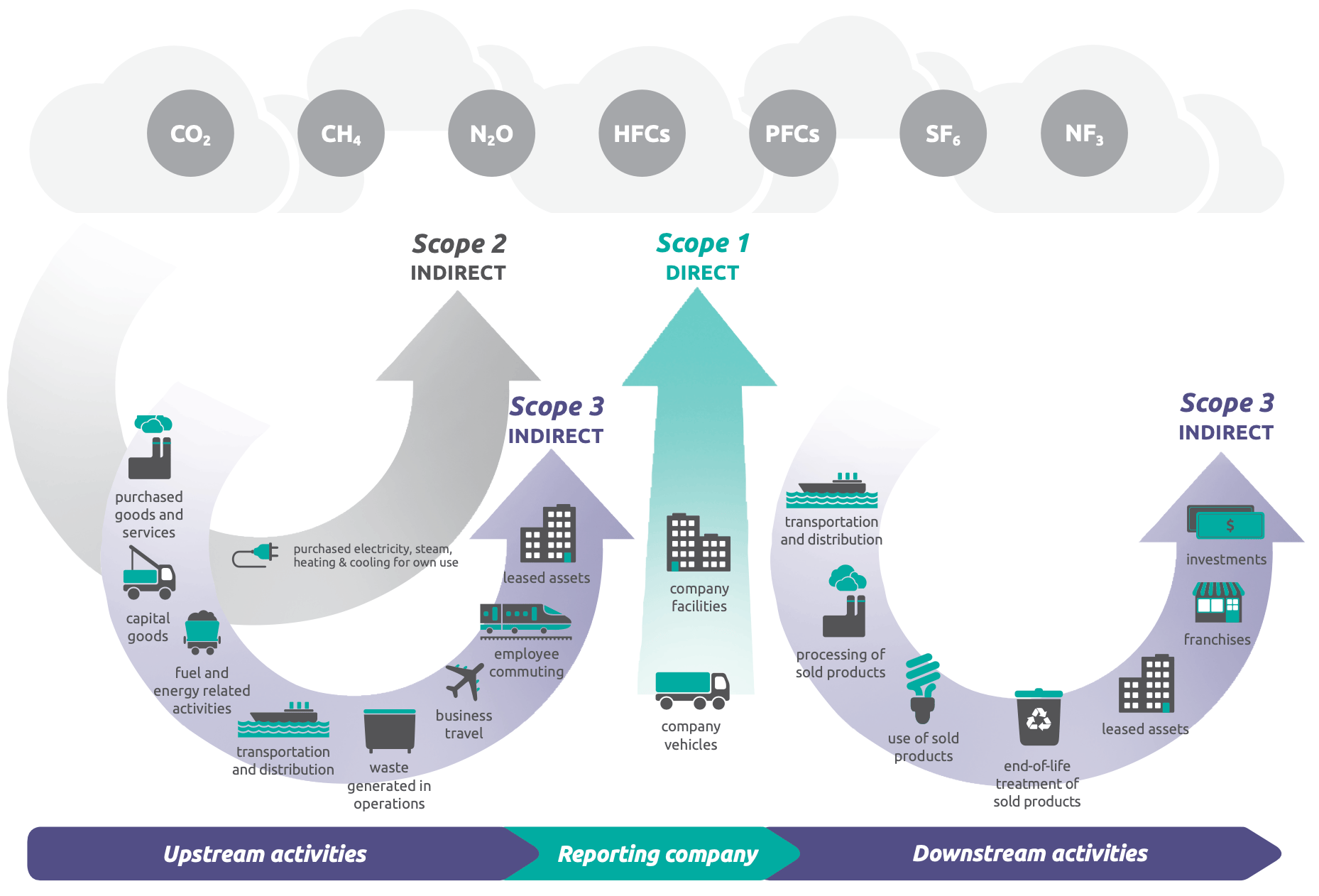
The GHG Protocol categorises emissions into three scopes to help businesses differentiate between direct emissions (Scope 1), indirect emissions from purchased energy (Scope 2), and all other indirect emissions across the value chain (Scope 3). See What are Scope 1, 2 and 3 Emissions? for a detailed breakdown of each.
Why Carbon Accounting Matters
By measuring and understanding GHG emissions, companies can:
- Identify opportunities for reducing emissions.
- Comply with regulations and standards.
- Enhance transparency and build trust with stakeholders.
- Contribute to global efforts to mitigate climate change.
Carbon accounting isn’t just a compliance exercise — it’s a powerful tool for driving sustainability and long-term business resilience. By taking a comprehensive approach and addressing all three scopes, businesses can lead the way in reducing their environmental impact and supporting a greener future.
Visualising the Three Scopes
The GHG Protocol provides a clear diagram to illustrate the relationship between Scope 1, 2, and 3 emissions. This helps businesses map their activities and identify areas where action can have the most impact.